Why is my sliding door so hard to open?
If you're bracing yourself and yanking a door that used to glide, this is for you. Nine times out of ten the door isn't the problem — a small part underneath is.
Published Aug 25, 2026 · Updated Aug 25, 2026 · ~6 min read
Symptoms that point to the rollers
Sliding doors fail in a pretty recognizable pattern. See how many of these match yours:
- The door feels heavy the whole way, not just at one spot.
- You hear grinding, crunching, or scraping as it moves.
- There's a scratched line along the bottom track.
- The panel sits crooked — the gap at the top is wider on one side.
- It occasionally catches or feels like it wants to come off the track.
Even, all-the-way heaviness points to rollers. Catching at a single point points more to the track. Often it's a combination.
What's actually causing it
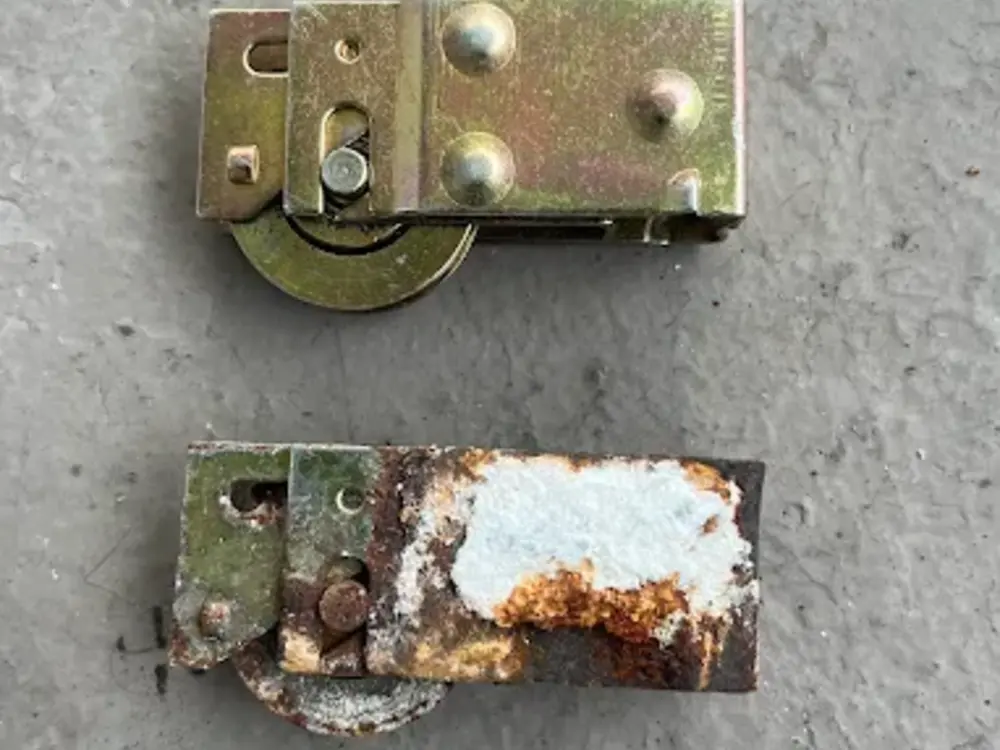
Your door hangs on two roller assemblies that ride in the bottom track. Over years they wear — and a few things speed that up dramatically:
- Corrosion: moisture and salt air rust the bearings and axles until the wheels no longer spin freely.
- Debris: sand and grit pack into the track and wheels and grind them down like sandpaper.
- Flat spots: a stuck wheel gets dragged instead of rolled, wearing a flat that makes it worse each time.
- Misadjustment: the height screws drift, so the panel rides low and scrapes.
Quick checks you can do first
Before you call anyone, two things are worth trying:
- Clean the track. Vacuum it out, then wipe the channel. A surprising number of "heavy" doors are just choked with sand. Skip heavy grease — it collects grit. See how to clean a track properly.
- Try the adjustment screws. At each bottom corner of the panel there's usually a small screw that raises or lowers the roller. A quarter-turn can lift a scraping door. If a small adjustment doesn't restore a smooth glide, stop — the rollers are likely worn.
What we don't recommend is forcing it or prying the panel out yourself. These panels are heavy and awkward, and a slip can crack the glass or bend the frame.
When to call a pro
Call when cleaning and a small adjustment don't fix it, when you hear grinding, or when the door is starting to come off the track. Roller replacement means removing an 80–200 lb glass panel safely, matching the right roller, cleaning and checking the track, and re-hanging the door square. It's routine work with the right tools — and genuinely risky without them. Here's what's involved in roller replacement.
The St. Augustine factor
If you live in St. Augustine or anywhere along the St. Johns County coast, expect rollers to wear faster than the manufacturer ever intended. Salt air, humidity, and sand are relentless here. It's why "my door got heavy" is the most common call we get — and why we suggest heavier-duty, corrosion-resistant rollers when we replace them, so the next set lasts longer. More on that in how salt air damages coastal doors.